Extraterrestrial Intelligence has fascinated us ever since the 1960’s onwards era with the rise of futuristic tv shows and films, some of the most notable include Star Wars and the original Space odyssey. The search for extraterrestrial intelligence, also known as ‘SETI’ is a collective term for scientific searches surrounding extraterrestrial life. Ever since the 1960’s there have been multiple projects that have been started to make progress towards the search. One of the earliest and most notable projects that I will be discussing is the set up of the Arecibo project.
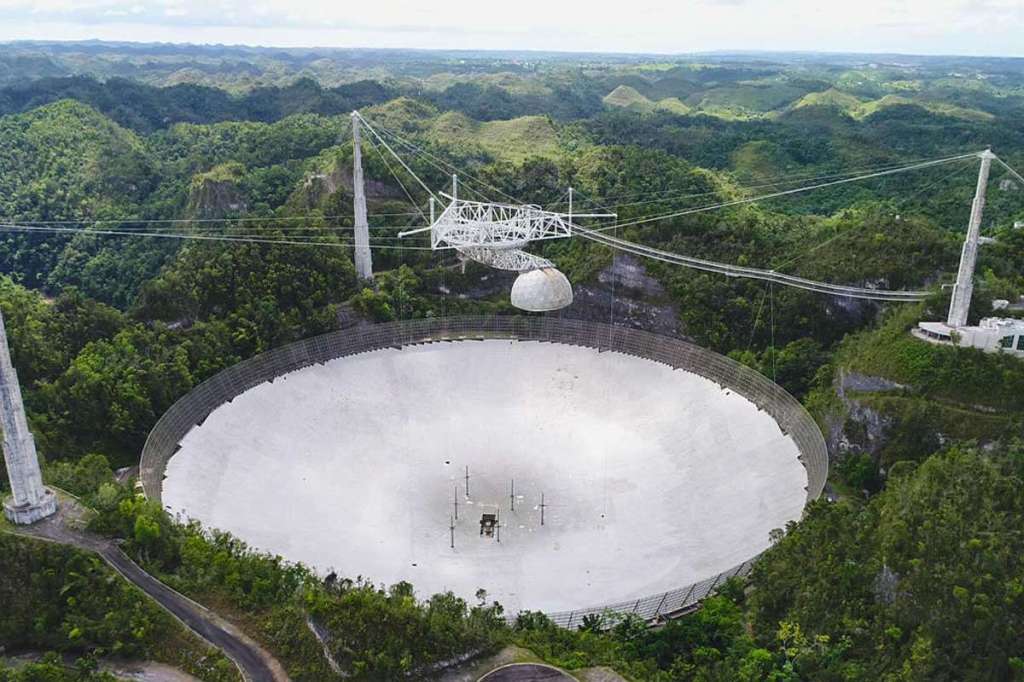
The start of the Arecibo project was kicked off by the building and launch of the Arecibo Radio Telescope, which was completed in 1963. It was located in South America, Puerto Rico and it stood at a whopping 305m (1000ft)! Sadly in 2020 however it collapsed and is now made into an educational site. It held the title of largest single-aperture telescope for 53 years, until it was surpassed in July of 2016. The project was funded by NSF (National Science Foundation) and NASA.
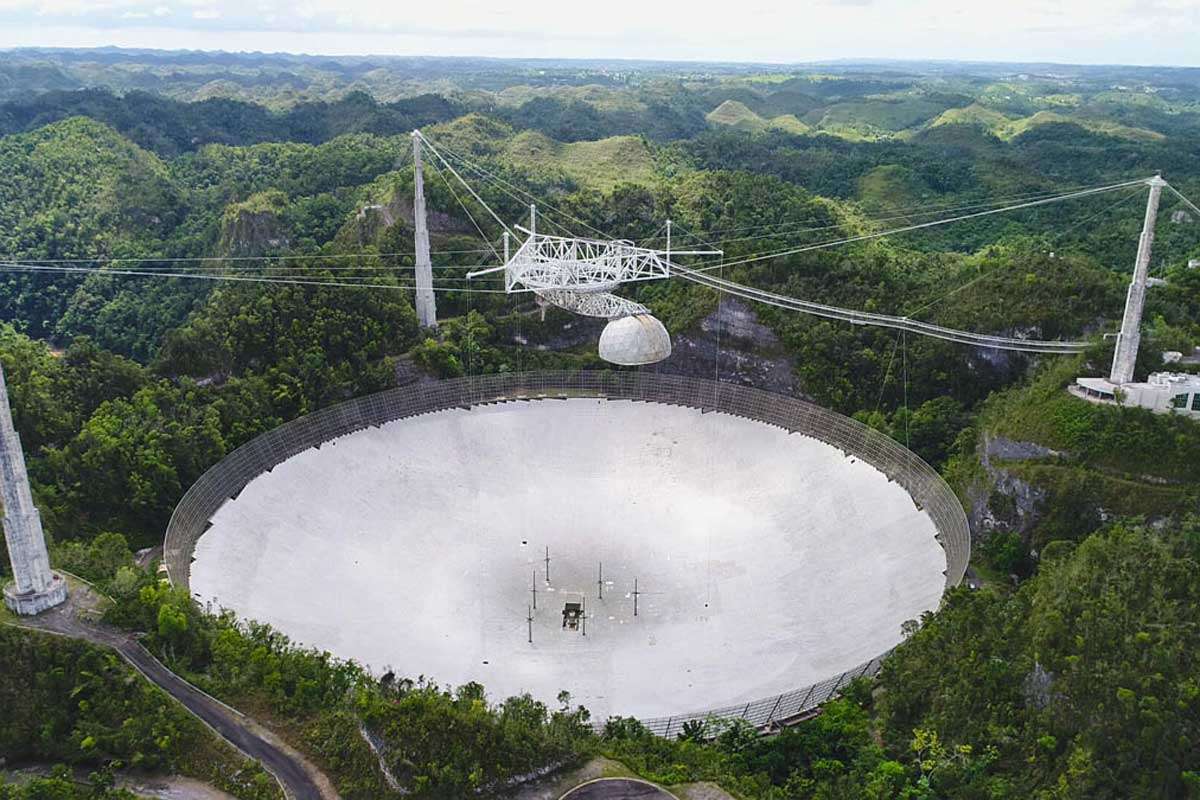

Telescope
The telescope itself had a large spherical dish that was made from over 38,000+ perforated aluminum panels (each about 1m by 2m), this whole structure was suspended, supported by steel cables. The telescope also has 3 transmitters which transmit different frequencies, at a range of 1-10 GHz, this allows the telescope to enhance the radio waves of an even large range thus effectively allowing for a greater scope. Since the signals that are picked up by the dish are too weak to detect by the instruments, a combination of transmitters and receivers work together to increase the amplitude of the wave, which allows for greater amplification that can then be detected. However in order to do this the waves must be coherent (waves having same frequency, wavelength and constant phase difference), that’s where having transmitters of a large range helps. Once these waves meet at a focal point (controlled by the movement of the 3 transmitters), they superpose and constructively interfere, creating higher and higher amplitude waves.
You now might be wondering, why are these specific ranges of frequencies chosen (1- 10 GHz)? In space the most abundant element is hydrogen, accounting for roughly three fourths of all baryonic matter. In a hydrogen atom there is one proton and one electron, each with its own spin. Sometimes the electron is aligned with the spin of the proton and others it’s opposite to its spin. When both the spins are aligned in the same direction it is in a ‘high energy state’, when it transitions to having the opposite spin it is in a now lower energy state. When this happens a decrite amount of energy is always released, this energy is in the form of electromagnetic radiation as it has a wavelength of 21 cm and a frequency of 1420.4058 MHz (≈ 1.42 GHz). This is the energy that is then transmitted and reaches our detectors on earth. Since space is made of many more different unique elements and compounds, each having different characteristic properties, it only makes sense to include a wide range of frequencies so that it’s range can be improved.
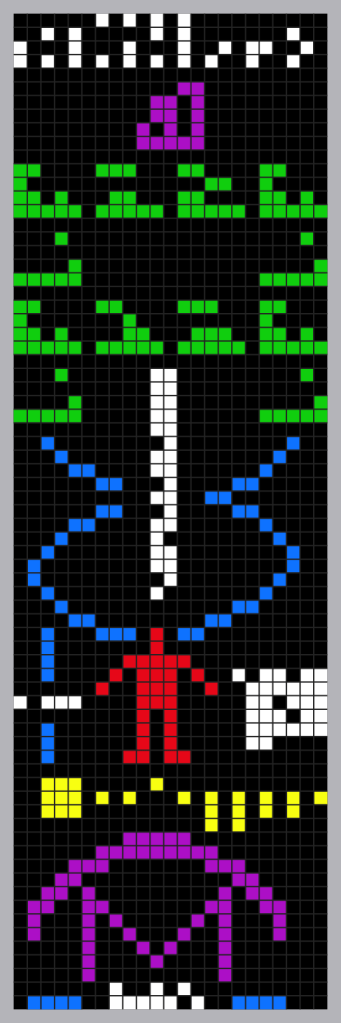
Along with the early efforts made to detect space noise, the project has famously also sent its very own message for anyone out there. This message was aptly named the ‘Arecibo Message’. This message was sent for an interstellar course, set to travel over 25,000 light-years to the globular cluster Messier 13 (M13). The message was broadcasted towards the galaxy cluster in 1974 via frequency modulated radio waves. This message was meant to be more as a demonstration of collective human technological achievements than a serious attempt to enter into conversation with an alien space civilization. The message itself consisted of seven parts (in order from top to bottom) (an image of the decoded message is shown below):
- The numbers one to ten (used as a key to decode the other sections of the message), (in white)
- The atomic numbers of the elements which make DNA, (in purple)
- Formulas of chemical compounds that make up nucleotides of DNA, (in green)
- The estimated number of DNA nucleotides in a human genome, (in white) and graphics of the double helix structure of DNA, (in blue)
- The dimensions of an average man (5’9’’), (in blue and white), a figure of a human being, (in red) and the human population of earth (at the time ≈ 4 Billion), (in white)
- A graphic of the solar system, (in yellow), with the sun on the right and the earth being raised towards the human figure above
- A graphic of the Arecibo radio telescope from which this very message was sent, (in purple, blue and white)

As of writing this the Arecibo message is only 0.2% of its way to the center of the M13 cluster. It still has another 99.8% of its journey left (another ≈24,950 years). Since then, other such messages have been sent out to space, one of such notable has been the golden record which was attached to the voyager 1 spacecraft. This message was the first physical object sent out to interstellar space, this held as a physical message… a preserved remembrance to anyone out there of who, what and where we as a human race are in the vast cosmos we call space.
Looking out into the future, as our scientific tools get more refined and technologically more advanced, we will continue to see more milestones being crossed and new feats being reached. The Arecibo project marked the beginning of SETI and was a stepping stone for many more future progress to be made.



 Science Articles.
Leave a reply to draashimasalwan Cancel reply